Education & ICT
As noted before, consider this summary non-exhaustive/incomplete. The materials for this course were scattered, and overall it was quite vague what was important and what wasn’t.
I tried my best, but I am not \(100\%\) confident. Good luck.
Can media influence learning?
Kozma (transformative perspective)
Kozma puts that educational technology is a design science; the phenomena we study are products of our own making. If there is not yet a relationship between media and learning, we have not made one, yet.
He claims we fail to see this relationship due to the behavioural roots of our field. We examine cause and effect, but rarely the causal mechanism. We look at the surface features of a medium (the stimuli), and then compare performance on a test (the response). According to Kozma, we should instead be studying the structure of the media and how it can sollicit cognitive processes associated with learning.
Media has three attributes:
- Technology: the physical, mechanical or electronic capabilities of a medium, determining its features. We use technology to classify media, such as ‘television’, ‘radio’, ‘tablet’ etc.
- Symbol systems: the way of transmitting information via the medium; examples include spoken language, printed text, pictures, numbers, musical score, maps, graphs etc.
- Processing capabilities: the ability of the medium to manipulate/operate on symbol systems; eg. displaying, receiving, storing, retrieving, organising, translating, transforming, evaluating etc.
Given these properties, any medium can be profiled and described in terms of its attributes, which determine the capacity to present certain representations or perform certain operations. Given the fact students perform the same representations and operations mentally, these attributes may influence learning.
A critique (by Clark) of this perspective is that attributes of media are neither unique nor necessary to a specific medium. In other words: the capabilities of a TV can be seen in another medium (eg. a computer), and may also be unused (eg. using the TV for displaying static images). Therefore, learning benefits can not be accounted to the media in question.
It must be noted that a distinction can be made between attributes and variables:
- An attribute is a property of a medium defined by its presence; it exists or not.
- A variable is a also a property of a medium, but defined by being present to a degree.
In other words: an attribute is a capability, a variable is whether this capability is used.
Kozma responds by saying individual attributes might not be unique to a medium, but the combination of different attributes can be distinctive nonetheless. Therefore, this unique combination of attributes can sollicit cognitive processes and thus learning benefits can be attributed to a certain medium.
Clark (instrumental perspective)
Clark instead claims media can never influence learning, because we confound media with instructional methods. That is, the instructional method is the ‘active ingredient’ of instruction, and can be delivered by a range of media (replacement hypothesis), given they offer the affordances needed for the method.
In this view, media are ‘mere verhicles that deliver instruction, but not influence student achievement’. Methods influence learning, media influence timely access/delivery and cost of doing so.
Therefore, the choice for media is purely economic. The designer must choose the least expensive and most cognitively efficient way to deliver instruction.
With regard to media attributes, Clark says the following: a number of distinct media attributes can serve the same cognitive function. Therefore, the attributes must be proxies of other variables (the underlying instructional method).
Technology-enhanced learning
TAM-model
The TAM-model is a predictive model used to predict the success of implementation of technologies.
flowchart LR
  U[Perceived usefulness] --> A
  E[Perceived difficulty] --> A
  A[Attitude towards using] --> S
  S[Actual system use]
The factor ‘perceived usefulness’ weighs more. That is, we might decide to learn how to use a technology that is difficult if we think it can be extremely useful to us, but we probably won’t adopt technologies that we perceive as useless, even if they are very easy to use.
SAMR-model
The SAMR-model describes how the use of technology can impact learning in two ways: enhancement and transformation.
-
Enhancement
- Substitution: technology is a direct functionally-identical tool substitute.
- Augmentation: technology is a tool substitute with functional improvements.
-
Transformation
- Modification: technology enables significant task redesign.
- Redefinition: technology enables creation of new tasks previously impossible.
Blended learning
Blended learning (sometimes ‘personalised learning’) is education in part face-to-face, in part online, with some element of student control over time, place, direction, and pace.
The lecture-format, which originated as an efficient way to copy books, is long outdated and has a few flaws:
- Cognitivist angle: it does not stimulate active processing of information.
- Constructivist angle: it is centered around the teacher as transmitter of knowledge, and not around the construction of knowledge by the student.
A good teacher helps students become critical thinkers and creative problem solvers. Blended learning is fit for this purpose, since it provides more learning oppurtunities and the student has an active role.
Forms of blended learning
-
Flipped classroom: students study online materials before class, and then process the materials actively during face-to-face time. This is reverse of the ‘traditional’ approach, where materials are explained face-to-face, and then processed after class via homework.
-
Station rotation: there are multiple activities (‘stations’) within the classroom, typically one teacher-led, one online, and one collaborative, that students switch between, either at a set interval or at teacher-discretion.
-
Lab rotation: similar to the station rotation model, but stations are locations rather than in-classroom activities, and one typically being a computer lab.
-
Individual rotation: students switch between different activities and modalities on an individually customised schedule, by which they do not necessarily visit all available stations.
Advantages of blended learning
- Online materials can add variety or authenticity
- Learners have more control over pace, frequency, place/time
- Ability to use testing effect via frequent quizzes
- Automated feedback can be provided more frequently and timely
- Promote active learning via activities, rather than passive processing
- Combines multiple media, which is known to be beneficial to learning
- Better access (due to distance & travel, which costs money)
- Potential cost reduction for the institute (less classrooms, facilities etc.)
Disadvantages of blended learning
- More time consuming for both students and teachers
- Active learning takes more effort for students
- Designing in-class and online curricula is more demanding for teachers
- Self-regulated learning can be demanding for students
- Study-life balance: border between classroom and home fades
- Less social interaction
- Tracking and combining multiple sources of information is more demanding
- Technical difficulties with online learning
- Worse access (due to internet & devices, which cost money)
- Potential extra costs for institute (redevelop curricula, maintain IT infrastructure etc.)
Self-determination theory
Blended learning is effective because it reduces cognitive load (due to increased learner control), and takes into account self-determination theory. This theory consists of three factors:
- Autonomy: students have more control over own learning (place, time, pace, depth).
- Competence: students feel more competent because they come to class prepared.
- Relatedness: students feel more related to fellow students and teachers because they actively processing materials together.
Self-regulated learning
Self-regulated learning (SLR) refers to monitoring and adjusting own learning processes using cognitive and metacognitive stategies, by regulating motivation.
We describe self-regulating in a cycle consisting of three phases:
flowchart LR
    A[Planning & goals] --> B
    B[Strategies & monitoring] --> C
    C[Reflect & adapt] --> A
A blended environment requires more SLR skills from students to fully benefit from instruction. Additionally, it is an important life skill, and directly relates to higher achievement.
Factors to support or measure SLR
- Goal setting what do you want to achieve? when?)
- Time management (how much time will you spent? when?)
- Environmental structuring (where do you put your smartphone etc.)
- Help seeking (when stuck, do you know? and do you ask for help?)
- Task definition (do you know what to do?)
- Strategic planning (did it work? do you make changes?)
How can we support SLR in flipped classroom?
- Provide explicit SRL instruction (increases quality)
- Facilitate SRL by prompting (increases quantity)
Examples would be:
- Teaching SRL strategies explicitly
- Providing frequent reflection moments
- Helping with goal setting and planning
- Doing regular progress monitoring
From research we know that adding SRL prompts on their own to instruction does not influence performance, since students do not see their meaning/relevance, thus tend to ignore them. This is mitigated by adding explicit explanation.
Scientific evidence
The study by Fazal and Bryant (2019) looks at performance and growth measures for blended learning compared to only face-to-face:
- Performance (STAAR): face-to-face only scored higher.
- Growth (MAP): blended learning scored higher.
Both moderate effect sises. This is different from results by Mackey (2015), who reported higher scores for blended learning on both measures.
Another meta-analysis by Alten et al. (2019) also looks at learning outcomes and student satisfaction:
- Assesed learning outcomes: small, signitificant (\(g = 0.36, p < .001\)), high power.
- Perceived learning outcomes: small, insignificant (\(g = 0.36, p = .13\)), low power.
- Student satisfaction: no effect, insignificant (\(g = 0.05, p = .73\)), low power.
There was a high variety in student satisfaction. The net effect sise was close to zero. This implies the specifics of implementation of the flipped classroom matter a lot.
A comparible analysis by Spanjers et al. (2015) found very similar results for effectiveness and statisfaction. There was no overlap in analysed records, so both results are independent.
Alten et al. (2019) also recognises a few design characteristics possible moderators:
-
Quizzes: positive effect on learning outcomes due to frequent testing effect, and positive effect on student satisfaction.
-
Small group assignments: positive effect on learning outcomes, achievement, and student attitudes. (examples: pair-and-share, paired problem-solving, group discussions)
-
Lecture-activities: positive effect on learning; micro-lectures can be used to address misunderstandings or gaps in student knowledge, and also increases student motivation.
An earlier study by Baerpler et al. (2014) indicated reducing face-to-face classroom time had no effect on learning outcomes. However, the analysis by Alten et al. (2019) finds a significant negative effect on learning outcomes when reducing face-to-face time.
Multimedia
Multimedia refers to any combination of text and pictures, in any medium. This can be spoken or printed words, and still or dynamic pictures.
- Multimedia learning is about building rich mental understanding from multimedia.
- Multimedia instruction is presenting words and pictures with the goal of fostering learning. Examples would be instructional videos, animations, or game-based learning.
Mayer created a theory of multimedia learning, called cognitive theory of multimedia learning (CTML) based on Sweller’s cognitive load theory (CLT), based on the following premises:
- Working memory has limited capacity to be allocated to processes which can be relevant or irrelevant to learning (Baddeley’s working memory model).
- Visual and auditory information is processed in working memory via distinct channels or tracks (Paìvio’s dual coding theory), which we call modalities.
- By utilizing both modalities simultaneously we can effectively double working memory capacity.
In most cases, CLT and CTML can be used interchangebly.
Multimedia principles
Based on CTML, Mayer prescribes 10 principles for effective use of multimedia:
-
Coherence: omit seductive details, which unneccesarily increase extraneous load.
-
Signaling: it can be unclear what instruction refers to, leading to visual search, which wastes memory capacity. Lead the learner’s attention using arrows, colors, pointing etc.
-
Redundancy: avoid presenting the same information using multiple modalities at once. This wastes memory capacity and can also cause conflicts in attention.
-
Spatial contiguity: present related visual information close together; for example place labels inside diagrams or graphs rather than in a legend. This reduces split-attention search, which occurs when the learner needs to focus on two things at once.
-
Temporal contiguity: in animations and videos, provide visuals and voice-over at the same time, rather than providing explanation after the visuals.
-
Segmenting: ensure concepts are not covered too quickly; working memory capacity and attention-span is limited and learners get tired. Slow down presentation, and split information into smaller, more easily digestible chunks. Provide controls to replay transient information.
-
Pretraining: ensure the learner has sufficient prior knowledge to consume instruction.
-
Modality: present information using both visual and auditory modalities to effectively double working memory capacity; prevent overloading one modality and underutilizing the other. For example, pictures + spoken word is better than pictures + subtitles.
-
Personalisation: use more informal and casual language in textual content and voice-over. Language that is too formal can confuse or scare learners.
-
Voice: use human voices for voice-over, rather than computer-generated/robot voices.
Sepp et al. (2021) add additional principles:
-
Encourage movement:
- For procedural tasks involving movement, instruction containing movement (eg. videos or animations) are more effective when compared to a series of still pictures.
- For students, movement can be helpful, for example when plotting or transforming mathematical functions. Additionally, tracing (using a finger or pencil) may reduce working memory capacity.
-
Instructor visible: the instructor should be visible to increase social presence, and preferably also interact with materials, which can reduce cognitive load by signaling.
-
Instructor age: there is some research indicating that adult instructors lead to improved learning outcomes, probably due to a perception of expertise. (Take this with a grain of salt.)
-
1st person perspective: when providing demostrations involving procedural tasks, specifically using hands, do this from 1st person perspective. Doing it from 3rd person perspective requires the learner to mentally rotate or mirror the information, which wastes working memory capacity.
-
Frontal perspective: when recording videos, some research suggests that a frontal perspective is better than a sideways/lateral perspective, since otherwise students won’t feel adressed, which lowers social presence.
-
Show the process: drawing something live is better than showing a pre-drawn graphic. Drawing it live provides students with better insight, prevents overwhelming students with the full drawing at the start, prevents distracting students by details that are only relevant later, and building the drawing up slowly prevents split attention search.
-
Spaced learning: space out learning over a longer period of time. This is related to the Ebbinghouse’s curve of forgetting, but also especially in online settings (zoom-fatigue is very real), time to reset and replenish cognitive resources is important.
-
Generative strategies: as also discussed in OVL, passively processing information does not lead to lasting learning.
Learning by creating multimedia
Learning by creating (instructional) multimedia is similar to learning-by-teaching, but in an indirect/non-interactive manner. It is effective for three reasons:
-
Retrieval practise: during preparation, students recall and then complement information from memory.
-
Cognitive explanation: generative processes create germane load by elliciting elaboration and metacognitive monitoring. They can also expose knowledge gaps.
-
Social-cognitive explanation: social presence as mediating factor of generative processes.
Social presense is defined as the degree to which students are aware of the audience. It has two influences:
- In online learning, social presence is related to increased participation, and lack of social presence is correlated with less motivation.
- It creates psyiological arousal, which is a bodily state of ‘activiation’ that is positively linked with performance. However, there is a threshold where it becomes overwhelming and loses this positive influence.
Scientific evidence
A meta-analysis by Risoba and Duran (2022) researches effectiveness of creating multimedia as an instructional method. It identifies four types of products: audio-visual, questions, texts, and educational games.
It also differentiates between knowledge telling and building:
- Knowledge-telling: summarizing source materials with little elaboration.
- Knowledge-building: elaborating on source materials, and fixing misunderstandings and gaps in knowledge.
In learning-by-creating, the focus should not be on the product, but rather processes such as:
- Revising contents
- Organising it for presentation
- Identifying structure
The study found that learning by creating multimedia a slightly (\(d = 0.17, p = .013\)) more effective than 1) nothing at all, 2) alternative interventions.
Two moderating factors where identified:
- Creating audio-visual or visual materials is more effective than textual materials.
- It is more effective when students have no access to source materials, because that enforces retrieval practise.
Game-based learning
Game-based learning (GBL) is hard to define. Instead, we use a simplified model (Plass et al., 2015) based on player enagement (affective, behavioural, cognitive and sociocultural).
This model assumes game design elements based on affective, motivational, cognitive, and sociological foundations, contribute to player engagement, which leads to learning outcomes.
flowchart BT
    L[Learning outcomes]
    A[Affective engagement] --> L
    B[Behavioral engagement] --> L
    C[Cognitive engagement] --> L
    S[Sociocultural engagement] --> L
    G[Game design elements]
    G --> A
    G --> B
    G --> C
    G --> S
    W[Affective] --> G
    X[Motivation] --> G
    Y[Cognition] --> G
    Z[Sociocultural] --> G
Importance of play
Games are hard to define, but play is widely understood to be important to the development of children because it activates schemas “in ways that allow children to transcend their immediate reality”. (In other words: it teaches symbolism.)
Genuine play is always symbolic and social. It is important because it creates a zone of proximal development for the child (Vygotsky, 1978). As children age, play becomes even more abstract, symbolic and social.
Why game-based learning?
There are many arguments for GBL. As a short summary, good games:
-
Neither too easy (boring) nor too hard (frustrating). Aim for a “sweet spot”, where players can succeed with some struggle. This is called flow, but can also be described as the zome of proximal development (Vygotsky, 1978).
-
Motivate the learners. We call the ability of a game to motivate, and to generate desire for players to return or continue playing, its stickiness.
-
Allow many ways to engage learners, depending on design decisions related to the learning objective, learner characteristics and context. According to the INTERACT-model (Domagk, Schwartz, & Plass, 2010), there’s four forms:
- Cognitive engagement: mental processing and metacognition.
- Affective engagement: emotion processing and regulation.
- Behavioural enagement: gestures, embodied actions, movement.
- Sociocultural engagement: social intereactions embedded within cultural context.
The end goal is to foster cognitive engagement of the learner with the learning mechanic.
-
Adapts to the player; engages with each learner in a way that reflects their specific situation. This is done by 1) measuring the variable the game adapts for and 2) providing an appropriate response (modification of task, scaffolding, guidance, and feedback etc.)
-
Allow for graceful failure. Rather than describing an undesirable outcome, failure is a by expected, and sometimes even necessary, step of learning. Games encourage risk-taking and exploration by offering lowered consequences.
Game design elements
-
Game mechanics: essential gameplay. The (sets of) activities repeated by the learner throughout the game. These can be learning or assesment mechanics.
Mechanics are often used to categorise genres of games.
-
Visual aesthetics: look-and-feel of the game and characters, but also the representation of key information in the game, as well as visualisations of mechanics, cues, and feedback.
Design can have a cognitive or aesthetic function.
-
Narrative: the storyline (cutscenes, dialogue, voice-over etc.), has a motivating function, and also provides contextual information. A storyline can be linear or nonlinear. Non-linear storylines can change depending on the player’s choices.
-
Incentive system: motivational elements such as rewards that encourage players to continue.
- Intrinsic: contributes to gameplay (ie. power-ups or keys).
- Extrinsic: does not contribute to gameplay (ie. stars or points).
Extrinsic incentives can also create a metagame, where players compete with eachother outside the game, for example via leaderboards.
-
Musical score: consists of the soundtrack and effects, used to direct attention, signal danger or opportunity, induce emotions or acknowledge success or failure.
-
Content and skills: the subject matter the game teaches, influences all other design elements, depending on one of four functions of the game:
-
Preparation of future learning: provides students with shared experience or knowledge used in later learning activities.
-
Teaching new knowledge and skills: provides initial presentation of new knowledge or skills, along with initial practise.
-
Practise and reinforce existing knowledge and skills: provides oppurtunities to practise and automate existing knowledge or physical/cognitive skills.
-
Developing 21st-century skills: provides opportunities to develop more complex socioemotional skills related to teamwork, collaboration, problem solving, creativity, communication.
-
Foundations of game-based learning
Cognitive
Bovenstaand is het Wijze lessen model van generatieve/productieve strategieën. Bij OVL houden we een ander model van Jonassen uit Morrison aan.
-
Situatedness: in games, learning can take place in a meaningful and relevant context, closely mirroring real life (which facilitates transfer), and providing information at the precise moment when it will be most useful.
-
Transfer: games support the application of knowledge and skills in a novel context, via the low road (automation) or high road (abstraction), facilitated by repeated opportunities to practise and apply materials in different situations.
-
Scaffolding: games can provide scaffolding, by doing ongoing dynamic evaluation, using that to provide dynamically adaptive scaffolds, and the progressively fading the scaffolds as the learner progresses.
-
Gestures and movement: games enable embodied cognition, which involves motoric engagement and mapping gestures or movements to subject matter (‘gestural congruity’).
Motivational
| Question | GBL affordance |
|---|---|
| Can I do this? | Games ensure achievement by dynamic adaptivity, so the question can be affirmatively answered. |
| What do I need to do to succeed? | Games ensure players know what to do during gameplay. |
| Do I want to do this, and why? | Intrinsic and extrinsic motivational factors from incentive systems. |
-
Intrinsic motivation: well-designed educational games feature design elements such as challenge, curiosity, and fantasy which are intrinsically motivating and result in effortless learning.
If learning and mechanics are not tightly linked, students may be intrinsically motivated to play but not to learn, which may lead to “gaming the system”, where students find ways to play without necessarily learning the subject matter.
-
Values and interest: students are more motivated if they are personally interested. Interest can be situational or individual:
- Situational interest: giving attention to an immediate activity or task at hand.
- Individual interest: intrinsic desire and tendency to return to an activity or task.
With a well-designed game, situational interest in the game will eventually develop into individual interest in the subject matter.
-
Achievement-related goals: there are two main reasons for students to engage with a game (or any educational material for that matter):
- Mastery orientation: students focus on learning and mastery of skills or knowledge.
- Performance orientation: students focus on maximazing favorable evaluations of their competence.
Students with a mastery orientation are more likely to be motivated.
Affective
- Emotional design: games can induce emotions via visuals, music, mechanics, storyline, and narration, and can also asses emotions and respond to them.
Affection vs cognition
Postive emotions might broaden the scope of cognitive resources (via heightend situational interest), but by optimizing engagement and stickiness might also lead to higher cognitive load. Additionally, emotional regulation required by games might overwhelm learners. However, there is also evidence that confusion might enhance learning.
Sociocultural
Games not not necessarily explicitly include cultural factors, but do often unconciously include or exclude for example colors, sounds, words, numbers based on ingrained and automated knowledge from the sociocultural background of the designers.
-
Activity theory: the motivational value of games lies in anticipated social interaction. Activities are based on interest- and friendship-driven social participatory structures.
-
Social context: a sense of community and participation can positively influence motivation and learning. This is easily done in multiplayer games, but singleplayer games can also use mechanics to create social pressure or metagames.
-
Agency: a sense of agency can positively influence motivation and goal orientation. There are three ways to exercise agency:
- Personal agency, exercised individually.
- Proxy agency, exercised through others.
- Collective agency, exercised as a group.
Proxy and collective agency can teach collaboration and joint goal-setting.
-
Observation: games may affect not only players, but also observers who also engage and focus equally on gameplay. Observers can offer advice and encouragement. In some cases, observers might learn more from the game than players themselves.
-
Relatedness (from self-determination): the sense of being connected to others can positively influence motivation, engagement, and stickiness.
However, players may refrain from social interaction when they have low stats, because they do not want to be seen by others as noobs. Therefore, to maximise relatedness, games should cluster players in cohorts of similar abilities.
-
Crowdsourcing: a specific type of game that uses AR to create authentic situations that incorporate real-world objects, where during gameplay data for research purposes is collected. Being part of a ‘greater good’ is a very motivating factor in these games.
Scientific evidence
Research by Lei et al. (2022) indicates GBL leads to substantially increased learning outcomes. They also found a number of moderators:
-
Culture: in collectivist countries children are exposed to more extrinsic motivation during childhood and are thus more receptive to extrinsic incentives. In individualist countries extrinsic incentives can cause negative effects. Since GBL uses both intrinsic and extrinsic motivation, it is more effective in collectivist countries.
-
Achievement indicator: games are especially beneficial to learning science, since the GBL-process has many parallels with science inquiry processes. Therefire GBL is more effective for science-related subjects, in comparison to other subjects.
-
Grade level and age: primary school students are more familiar with play and less familiar with other instruction/practise (eg. homework), so comparitively, it works better for them than for higher education.
AR/VR
Virtual reality (VR) enables sensory immersion and sophisticated content representation, capable of simulating real or imagined worlds.
Augmented reality (AR) enables representation of real and virtual simuntaneously, supporting real-time interactions, where real and virtual objects are aligned (‘geometrical registration’).
There are four types of AR:
- Location-based uses GPS data to match real-world locations.
- Vision-based (or ‘markerless’) uses image recognition to display objects on the camera.
- Spatial projects information directly onto physical objects.
- See-through (or ‘mixed reality’) uses glasses to overlay virtual objects on the real world.
CAMIL-model
The CAMIL-model describes learning in immersive virtual reality (IVR). Immersion refers to sensory vividness and ability of the system to shut off the outside world.
Head-mounted displays (HMDs) are regarded high-immersion, a tablet of smartphone is regarded low-immersion.
The model describes how technological factors of IVR can facilitate higher presence and agency, which influence affective and cognitive factors that can lead to knowledge acquisition and transfer.
This model assumes Clark’s perspective on media. It states affordances of IVR can enable or enhance instructional methods. It also recognises that motivational and learning theories developed for less immersive technology generalise to IVR.
flowchart LR
    I[Immersion] --> P
    C[Control] --> P
    C[Control] --> A
    F[Fidelity] --> P
    P[Presence]
    A[Agency]
    P --> CAF
    A --> CAF
    CAF[Cognitive and affective factors]
    CAF --> FACT
    CAF --> CONCEPT
    CAF --> PROC
    CAF --> TRANS
    FACT[Factual knowledge]
    CONCEPT[Conceptual knowledge]
    PROC[Procedural knowledge]
    TRANS[Knowledge transfer]
Technological factors
- Immersion: sensory vividness and ability to shut off the outside world.
- Control: degree to which the environment and sensors can be modified.
- Fidelity: realism of the environment and smoothness of view changes.
Psychological factors
- Presence: feeling of ‘being there’, influenced by:
- Vividness of sensory information presented (immersion)
- Amount of control the learner has over sensors (control)
- Degree to which the environment can be interacted with (control)
-
Agency: feeling of generating and controlling actions.
Low-agency would refer to fixed-narrative environments without interaction (no control).
High-agency is achieved by accordance between actual movement and visual feedback (control), and the ability to control the virtual representation of self (control).
The CAMIL-model identifies three dimensions of presence:
- Physical presence: degree to which virtual objects are experienced as physical objects.
- Social presence: degree to which virtual actors are experienced as actual social actors.
- Self-presence: degree to which virtual self/selves are experienced as actual self.
Cognitive and affective factors
-
Interest: high agency can have a positive effect on situational interest (see GBL).
-
Intrinsic motivation: high agency leads to higher levels of enjoyment; high social presence can lead to feelings of higher competence and relatedness (see blended learning).
-
Self-efficacy: performance accomplishments have a greater positive effect on self-efficancy if actions are perceived to be “real” (presence) and learner’s own (control).
-
Embodiment: high self-presence leads to higher embodiment (‘feeling of owning or controlling a body’), and is associated with cognitive and affective processes.
-
Cognitive load: high agency can lead to higher extraneous load; IVR as medium imposes a higher extraneous load as well, resulting from seductive details.
-
Self-regulation: high-social presence can increase SRL through interactions with peers or teachers; due to high cognitive load imposed by IVR heavy scaffolding and frequent reflection opportunities may be required.
Learning outcomes
-
IVR is less effective for acquiring factual knowledge, and not more or less effective for acquiring conceptual knowledge. Specifics depend on the design of IVR lessons.
-
IVR is particularly fit for teaching procedures, because the technology can be used to replay, slow down and repeatedly rehearse procedures easily. Additionally, it can be a good replacement for procedures that are expensive, inpractical, or dangerous to train in real life.
-
IVR models real-world situations closely (high fidelity) and might thus enhance transfer of knowledge from the classroom to real life situations.
Multimedia principles applicable to IVR
- Pre-training can help because learners with higher prior knowledge can more easily intepret IVR experiences in a meaningful way.
- Segmenting can help to reduce cognitive load by dividing lessons in shorter, more focussed, and thus less distracting and exhausting chunks.
Scientific evidence
A study by Buchner et al. (2021) states AR is beneficial for learning due to the potential to overcome the violation of Mayer’s multimedia principles.
Their meta-analysis identifies six use-cases for AR and compares effectivity of different types of AR, as well as value-added studies:
-
For assembly lines, AR guidance can improve performance while reducing or keeping consistent cognitive load.
Impact of types of AR
Spatial AR was most effective, compared to vision-based or see-through AR.
This is in-line with Mayer’s split-attention and temporal contiguity principles, because spatial AR can be used to project instructions directly onto the components in the assembly line, reducing split-attention search.
Value-added studies
For vision-based AR, using a handle was better than using a tripod. For see-through AR it is best to use visual cues instead of written text.
-
For task assistence (surgery, navigating, driving, flying), AR leads to higher performance while reducing or keeping consistent cognitive load. It can also compensate for demands of a secondary task.
Impact of types of AR
There are no studies comparing AR types.
Value-added studies
3D visualisations lead to lower cognitive load, and thus higher performance, for see-trough and spatial AR.
-
For use as instructional tool to teach factual and conceptual knowledge, AR performed better than alternatives (eg. 2D visualisations).
Impact of types of AR
One study compared vision-based and see-through AR. No differences were found.
Value-added studies
I am confused.
-
For real-time feedback, one study found AR can improve performance and reduce cognitive load.
Impact of types of AR
There are no studies comparing AR types. (There was only one study.)
Value-added
Colored feedback leads to lower cognitive load, and thus higher performance, when compared to black-and-white feedback.
-
For spatial ability training for elderly, one study found AR can improve performance and reduced cognitive load, when compared to alternatives (eg. 2D visualisations).
Impact of types of AR
There are no studies comparing AR types. (There was only one study.)
Value-added
There are no value-added studies. (There was only one study.)
-
For collaborative problem solving, one study found AR can improve performance, while reducing or keeping consistent cognitive load, when compared to alternatives (eg. paper-based materials or standard software).
Impact of types of AR
There are no studies comparing AR types. (There was only one study.)
Value-added
There are no value-added studies. (There was only one study.)
Value-added studies compare the same educational technology in two or more versions.
Other findings of this meta-analysis include:
- 3D representations perform better than 2D representations when used in AR.
- A human actor is superior than any other form of visual cueing.
- Spatial AR performs better than see-through AR and vision-based AR. This is presumably because it does not need any additional equipment (glasses, smartphone, etc.) from the learner.
- In some studies cognitive load was higher in the AR-group, compared to the control group, but resulting in higher performance, which is not expected.
- Positive features are 3D visualisations, visual queing, and generative learning strategies.
Artificial Intelligence
The term AI refers to a variety of technologies. A distinction can be made:
- Educational AI: developed for education; for example intelligent tutoring systems (ITS).
- Generic AI: used in education; translation tools, writing assistants, conversational agents.
AI within education is primarily used for two reasons:
- to better understand learning and teaching (improve theories)
- to support learning and teaching
This can be seen from the perspective of the student or teacher:
- Student-faced supports learning; examples are adaptive learning and intelligent tutoring.
- Teacher-faced supports teaching; examples are learning analytics and plagiarism checks.
However, many tools, both educational and generic, are not theory-based, and some are not even theory-informed; of student-faced tools, only \(50\%\) is theory-informed, and of teacher-faced AI, only \(33\%\) is theory-informed.
Knowledge types
Bauer at al. (2025) identify two types of knowledge relevant to AI research:
-
Domain-specific knowledge is scoped to a particular field, and is needed for understanding and evaluating AI outputs, which may be misleading, biased, or incorrect.
-
Transversal skills are applicable across various domains, and are needed to interact with AI systems effectively and ethically, and critically evaluate their outputs.
ICAP-modal
According to the ICAP-model (Chi & Wylie, 2014) a distinction can be made between shallow learning (memorisation) and deep learning (synthesisation, evaluation & integration):
-
Shallow learning
- Passive: information is received without actively processing it.
- Active: existing knowledge is applied to promote retention but no insights.
-
Deep learning
- Constructive: novel idea generation (think ‘elaboration’).
- Interactive: the same as constructive, but collaborative.
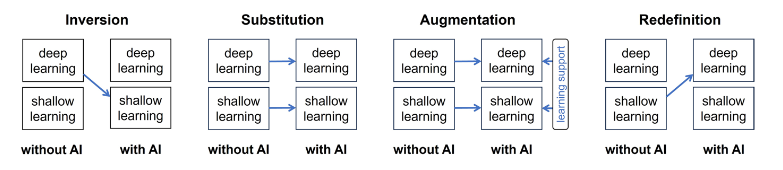
ISAR-modal
The ISAR-model is an extended version of the ICAP-inspired SAMR-model, which can be used for understanding the impact of AI on shallow and deep learning:
- Inversion: technology reduces learning processes and outcomes (over-reliance).
- Substitution: technology replaces tasks previously performed by students or teachers.
- Augmentation: technology enriches tasks with additional cognitive learning support.
- Redefinition: technology transforms tasks or creates entirely new tasks.
AI for formative writing feedback
Formative feedback is very important to students during the writing process. Good feedack is:
- Criteria-based (rubrics)
- Provides clear directions for improvement
- Accurate
- Prioritises essential features of writing
- Supportive in tone
A study by Steiss et al. (2024) found that ChatGPT provides high-quality feedback comparible to feedback given by experienced human educators. On average, humans still outperformed AI on all factors listed above, except criteria-based.
The following moderators were identified:
-
Quality of graded essays: accuracy of AI-generated feedback drops for higher-quality essays, as does the supportive tone.
Human feedback was more consistent across grading levels; only prioritisation of essential features was significantly higher for low-quality essays.
-
Language of graded essays: the language in which essays were written or feedback was provided did not have a significant impact on the quality of the feedback.
Replace teachers?
- Around \(6\%\) of a teacher’s tasks are highly automatable.
- Around \(20\%\) are bottleneck items (tasks that cannot be automated at all).
The rest of the tasks are somewhat automatable; there is a possibility for a ‘hybrid future’ where AI and humans collaborate.